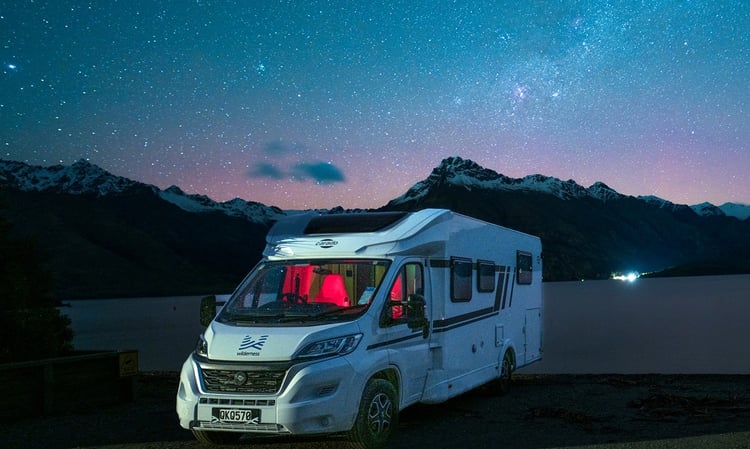
"Noctourism" – travel built around the night sky rather than the daytime – is gaining some attention. More and more travellers are choosing to relax during the day, and then emerge at night to start sightseeing.
Perhaps it’s not too surprising. Tourist destinations are crowded, global light pollution is rising, and the Milky Way is now invisible to a third of the world’s population. Stepping out into the pitch-dark night to find yourself under an arch of stars, with brilliant pink and yellow streaks of the Aurora Australis painting the sky – this might be turning into one of the rarest experiences of all.
It’s an experience that New Zealand does better than almost anywhere. This country is home to several certified Dark Sky places: reserves, sanctuaries, and townships officially recognised by DarkSky International for exceptionally low light pollution, usually thanks to shielded street lighting and strict outdoor lighting rules.
The South Island also sits close enough to the auroral zone that the Aurora Australis is a realistic sight in winter.
For travellers to New Zealand, a motorhome offers one of the best, most secluded vantage points to see the night sky in all its glory. That said, there are some things to plan for first. In this blog, we’ll cover six accessible, legal spots to view the night sky from your motorhome, plus everything else you need to know about freedom camping and winter travel before you go.
What are the top 6 accessible Dark Sky spots to view the aurora from a motorhome in New Zealand?
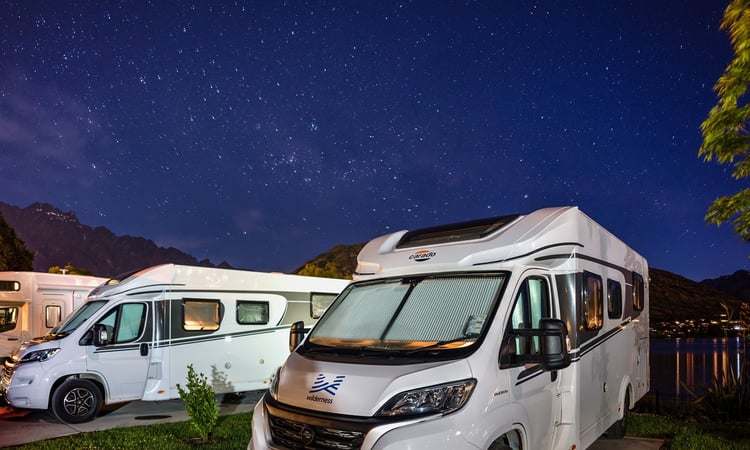
A good aurora spot on a road trip comes down to three things: how dark the sky is, how open your view is to the southern horizon, and whether you can legally park a motorhome there overnight.
The six places below all tick those boxes: each has official Dark Sky recognition, a clear run of sky facing south, and at least one legal, self-contained-friendly place to pull over and wait for the lights.
Here are our picks:
Aoraki Mackenzie International Dark Sky Reserve (Twizel / Lake Pukaki)
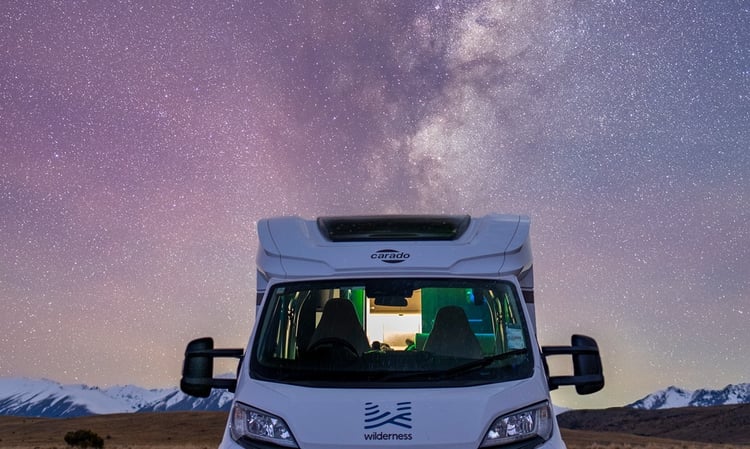
There's a reason this is the Mackenzie Basin's headline act. It's the Southern Hemisphere's largest dark sky reserve, and the only one with Gold-tier status – the highest rating DarkSky International gives out.
Park up on the shore of Lake Pukaki at night, and watch the mountains disappear into a black horizon while the sky fills in behind them. On a clear night, it’s an otherworldly experience that a daytime view will find hard to beat.
Key facts:
-
Size: over 4,300 km², covering Lake Tekapo, Twizel, and Aoraki/Mount Cook
-
Where to stay: Freedom camping directly on Lake Pukaki is now tightly restricted to signposted spots. Lake Pukaki's southern-end overnight parking area and the DOC site at Lake Poaka are both a short drive from Twizel and reliably open to self-contained vehicles.
-
Why it works for aurora: Wide, flat basin views give you an unobstructed southern horizon.
-
Check before you go: Current signage via the Aoraki Mackenzie Dark Sky Reserve.
Naseby / Maniototo, Central Otago
Naseby became New Zealand's first International Dark Sky Community in September 2025 – only the third town in the Southern Hemisphere to earn that title, after Niue and Carrickalinga. It's a former 1860s gold-mining settlement of around 140 people, ringed by working pine forest that blocks stray light from neighbouring towns.
By day, it's also New Zealand's home of curling. The country's only international-standard indoor rink is here, alongside an ice luge and ice-skating rink, so there's plenty to do aside from marvel at the night sky.
Key facts:
-
Certification: International Dark Sky Community, since September 2025.
-
Where to stay: Naseby Holiday Park (also called Larchview Holiday Park) has powered, unpowered, and freedom sites right in town, on the edge of the Naseby Forest Recreation Area – an easy, legal option if you'd rather not freedom camp roadside.
-
Access: Roads through the Maniototo are unsealed in places. Take them slowly at night, especially in an unfamiliar vehicle.
-
Why it works for aurora: Dimmed street lighting and surrounding forest mean the aurora is reportedly visible to the naked eye from the township itself on a clear night.
Tāhuna Glenorchy Dark Sky Sanctuary
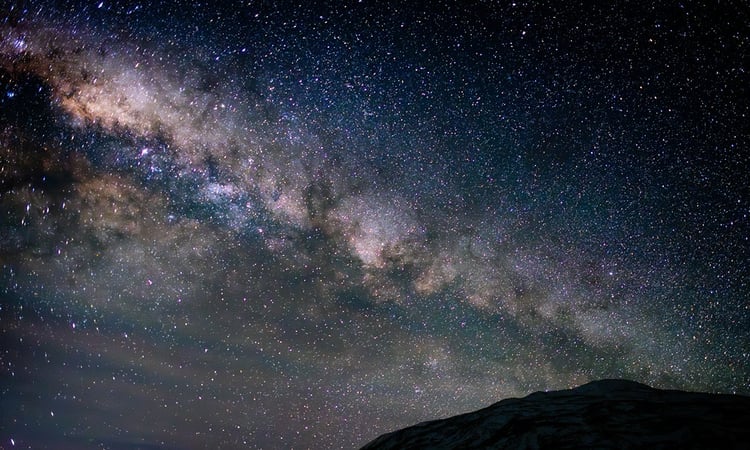
Image by Evan C
Glenorchy sits almost exactly on the 45th parallel, and is described by the sanctuary's founders as an astronomical "sweet spot". Only around 10,000 people worldwide live somewhere dark enough to see both the aurora and the core of the Milky Way in the same sky. Photographers here regularly capture the aurora reflected in the still water of Lake Whakatipu, shot from the Glenorchy wharf. The 200,000-hectare sanctuary also sits directly in the path of the 2028 total solar eclipse – the only Dark Sky Sanctuary in the world that does.
Key facts:
-
Certification: International Dark Sky Sanctuary, since February 2025 – New Zealand's fifth, and the 23rd worldwide.
-
Where to stay: We suggest heading to Kinloch Campsite – a DOC site with a small fee. The only freedom camping spots are at Glenorchy Domain Carpark, and there are just 3 designated spots.
-
Access: A fully sealed road from Queenstown via Bennett's Bluff (about 45 minutes), no gravel required.
-
Why it works for aurora: An open lake horizon facing south, doubled by its reflection on calm nights.
Oxford Forest Conservation Area (North Canterbury)
Oxford is a remnant of the beech and podocarp forest that once covered inland Canterbury, protected by day for walking and mountain biking, and by night for its sky. Certified in January 2024, it's New Zealand's second International Dark Sky Park, with measured sky readings as dark as 21.8 magnitudes per square arcsecond in places — Bortle 1, about as dark as it gets. It's also the most convenient spot on this list if you're starting or ending your trip in Christchurch, less than an hour's drive away.
Key facts:
-
Certification: International Dark Sky Park, since January 2024 – New Zealand's second, after Aoraki Mackenzie.
-
Where to stay: West Oxford Reserve (on the Eyre River, just outside Oxford township) is a well-reviewed, self-contained freedom camping site with vault toilets and plenty of room for larger rigs.
-
Access: Sealed roads, around 50 minutes from Christchurch.
-
Why it works for stargazing: Dense forest cover blocks light spill from surrounding towns, and around 70% of nights here are clear – though at roughly 43.2°S it's noticeably further from the auroral zone than the Queenstown-area spots on this list, so treat aurora sightings here as a possible bonus rather than the main draw.
Kaikōura Dark Sky Sanctuary
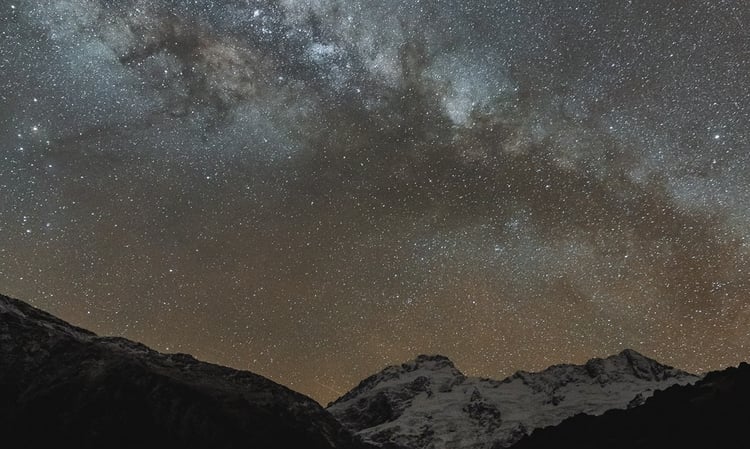
Kaikōura is New Zealand's only coastal Dark Sky Sanctuary, and the only spot on this list where you can watch whales, seals, and dolphins in the same 24 hours you spend stargazing. The Seaward Kaikōura Range rises straight out of the Pacific behind the town, and the sanctuary was originally driven by conservation efforts to protect the Hutton's shearwater – an endangered seabird that gets disoriented by artificial light when it fledges.
Recorded sky quality here averages 21.58 magnitudes per square arcsecond, close to the theoretical limit of natural darkness.
Key facts:
-
Certification: International Dark Sky Sanctuary, since September 2024. It’s New Zealand's New Zealand's third Sanctuary, and its only coastal one.
-
Where to stay: Kaikōura District Council runs five designated freedom camping sites for certified self-contained vehicles – West End car park (10 vehicles, right in town) and Jimmy Armers Beach (6 vehicles, ocean views, 7.5m length limit) are the two most popular; both are strictly one night per four weeks and fill up by mid-afternoon in season
-
Access: reachable via SH1, no gravel-road detour required
-
Why it works for aurora: An open ocean horizon with mountains blocking inland light spill, and a marine climate that often delivers clear, still winter nights
If you want the single best odds in the country and don't mind leaving the motorhome behind for a night, Rakiura/Stewart Island sits at 46.9°S – further south than Queenstown – with sky readings that regularly exceed 21.75 mag/arcsec², among the darkest measured anywhere on Earth. Park up in Bluff or Invercargill and take the hour-long passenger ferry across.
Wairarapa Dark Sky Reserve
Wairarapa became New Zealand's second Dark Sky Reserve in 2023, and is the only one on the North Island. It covers the South Wairarapa and Carterton districts about 100km from Wellington.
The core of the reserve is the Aorangi Forest Park, where measured sky quality reaches 21.8 magnitudes per square arcsecond – among the darkest readings recorded anywhere. One of the most photographed views in the reserve is the Milky Way rising over Cape Palliser Lighthouse on the south coast, a favourite for both local and visiting astrophotographers.
Key facts:
-
Certification: International Dark Sky Reserve, since 2023, covering the South Wairarapa and Carterton districts.
-
Where to stay: Martinborough TOP 10 Holiday Park sits right in the wine village; South Wairarapa also permits freedom camping for certified self-contained vehicles at a handful of designated spots, including the Lake Domain Reserve on Lake Wairarapa.
-
Access: Sealed roads, roughly 100km and under 2 hours from Wellington.
-
Why it works for aurora: It's a longer shot than the South Island spots – at roughly 41.4°S, Wairarapa sits considerably further from the auroral zone, so it's a better bet for stargazing. That said, aurora has still been sighted this far north during strong geomagnetic storms.
Expert tips on capturing the night sky on camera
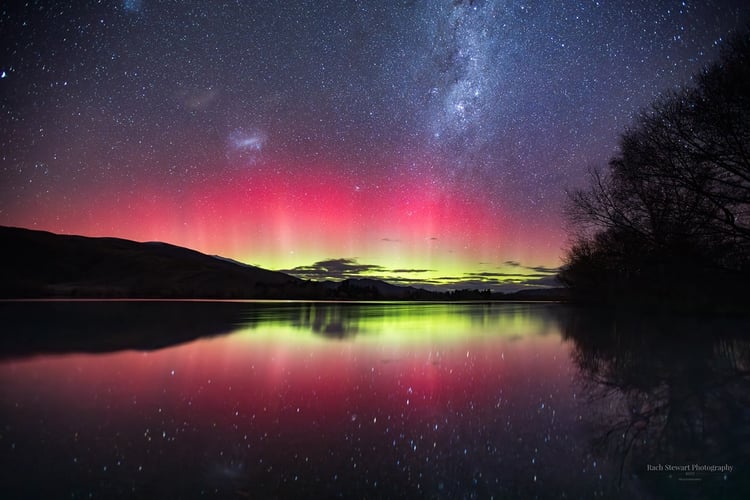
Image by Rach Stewart
If you’ve ever marvelled at the night sky and tried to take a picture, only to be met with a disappointing, blurry photo of nothing – you’re not alone. Capturing clear images after dark is notoriously difficult. That’s why we’ve asked professional landscape photographer Rach Stewart for her insights.

My experience photographing the night sky in New Zealand has been an incredible journey, and I was lucky that it started right at the beginning of my photography career.
Back in 2015, I had my first experience shooting the night sky in the Aoraki Mount Cook Dark Sky Reserve, arriving at the Church of the Good Shepherd at 2 am. I had never seen the church before, or the Milky Way looking so incredible above it. With clear skies and hardly anyone around, I captured the image I was hoping for.
My second unforgettable experience came in 2016 when some friends and I happened to be in the right place at the right time to witness an incredible Aurora Australis. Watching the sky literally dance in front of our eyes was a moment I’ll never forget. Shades of red, green and purple filled the night sky, creating a display that was even more incredible to witness with the naked eye.
Over the last decade, I’ve experienced some incredible night skies across New Zealand, so here are a few tips to help you capture your own.
Capturing the Milky Way
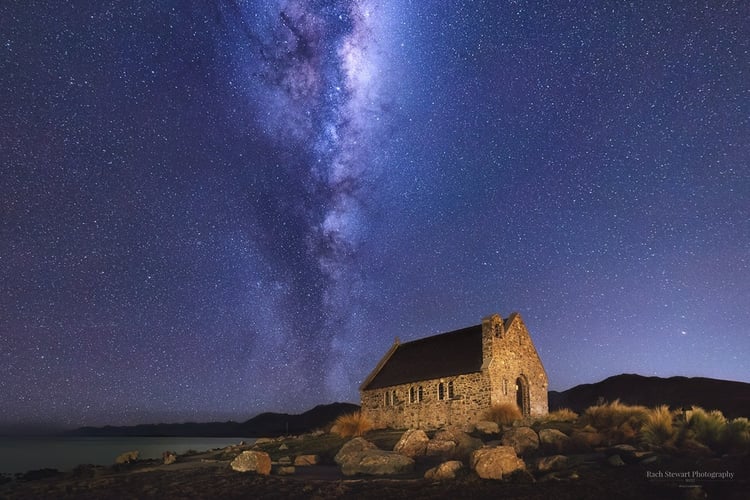
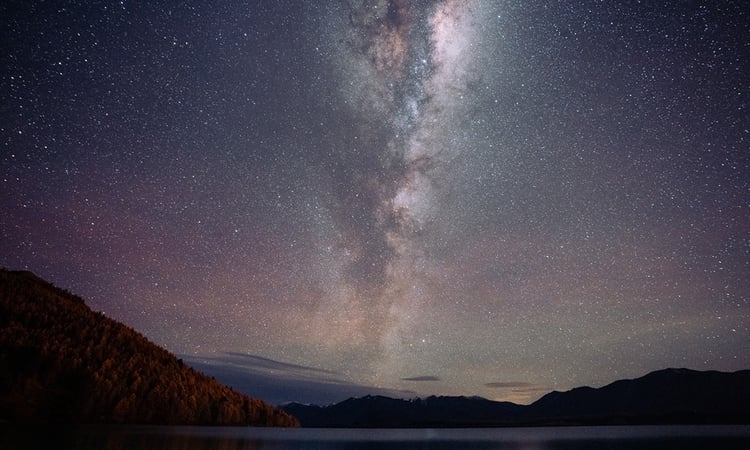
Image by Rach Stewart
The Milky Way is best photographed in New Zealand during the autumn and winter months (March to October) when the core is visible. Aim for a new moon and remember it’s not just about camera settings. Finding an interesting foreground is just as important. Think lone trees, lakes, mountains, roads, or a person to add scale.
-
Camera: Use a camera with Manual Mode and shoot RAW
-
Tripod: Essential for sharp images
-
Lens: A wide-angle lens (something like a 16-35mm) with a fast aperture makes a huge difference
-
ISO: Start around 3200-6400
-
Aperture: Start with the widest your lens allows (ideally f/1.4–f/2.8)
-
Shutter Speed: This can be tricky depending on what length you're shooting at, but it should usually be anywhere between 10-20 seconds. To avoid star trails and get it perfect, there are a couple of methods you can use explained here, but if you'd rather skip calculations, a little trial and error does not hurt (eg. 16mm on a Canon R5 = 15 seconds)!
-
Focus: Your auto focus won't work at night, so flick to Live View in manual mode, find the brightest star, zoom in, and manually adjust until it becomes pin sharp.
Capturing the Aurora
The same gear applies, but your settings will change depending on the strength of the aurora. Start around ISO 800 and adjust throughout the night as the solar storm changes. Shutter speeds are typically between 5–15 seconds depending on the brightness and movement of the lights.
For more tips on photographing the Southern lights, check out Rach’s website.
How do you safely prepare a motorhome for overnight aurora chasing in winter?
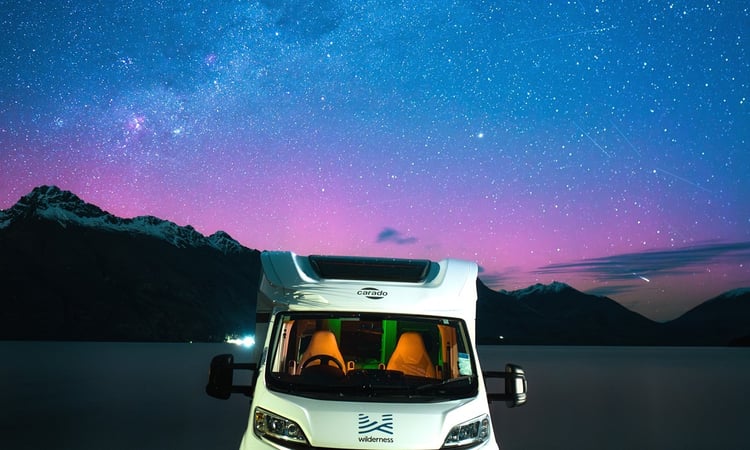
Winter is the best time to try – the nights are longer, giving you more dark hours to catch the aurora, and the crisp, dry air common on winter nights makes for clearer, less hazy skies than in summer.
The trade-off is that your motorhome needs to handle the cold well, and that comes down to preparation before you leave town, then managing power carefully overnight so you're not choosing between a working heater and a charged phone at 2 am.
-
Before you go: check house battery state of charge, gas bottle levels, and tyre pressure. Cold nights are hard on all three, and gravel or frosted roads punish underinflated tyres.
-
Power management overnight: Running gas heating instead of a battery-draining electric heater preserves charge for the lights and any battery-powered gear you'll need when the aurora appears.
-
Cold-weather basics: If you're travelling in winter, choosing a fully winterised motorhome is vital. That means good insulation, double-glazed windows, and a reliable heating system that doesn't rely on mains power. Wilderness motorhomes are built with all three as standard, so alpine or coastal nights below zero shouldn't catch you out.
-
Packing for the viewing itself: Warm layers, a thermos, and a plan to switch off engine and interior lights once you're set up. Both count as light pollution and battery drain right when you need neither.
-
Keeping gear charged: We always suggest hiring a motorhome with an inverter. This nifty piece of kit turns your house battery's DC power into standard AC, so you can charge phones, cameras, and laptop batteries overnight without needing to run the engine or find mains power – handy when you're set up somewhere remote waiting for the sky to clear.
What are the freedom camping laws for motorhomes in New Zealand's Dark Sky Zones?
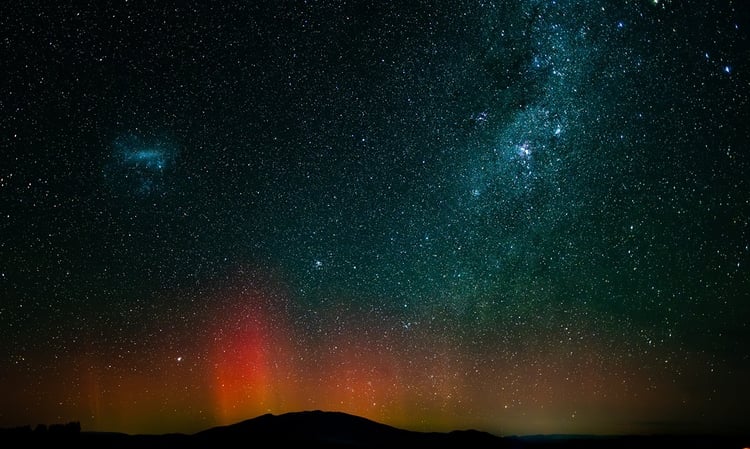
Image by Evan C
As of 7 June 2026, every self-contained vehicle freedom camping in New Zealand needs a Green Warrant – a new mandatory self-containment certification, which replaced the old "blue sticker" system. Most reputable rental motorhomes, including Wilderness vehicles, are already certified to this standard, but it's worth confirming before you head off. Freedom camping in a non-compliant vehicle risks fines from $200 up to $2,400.
Where DOC and council rules overlap
DOC land and council land run under different rules, even when the areas overlap. Glenorchy is a good example of why that matters.
Under council bylaws, you can't sleep overnight in public car parks, on lakeshores, or at roadside stops. Under DOC rules, trailhead car parks like the Routeburn or Rees-Dart are day use only, with no overnight camping even if you're self-contained. So you need a spot that complies with both – in Glenorchy, that's the Glenorchy Domain Carpark, which allows self-contained vehicles to check in after 6:00pm and leave by 8:00am.
How night limits work
Let’s take Kaikōura as an example. There are five council-designated freedom camping sites, including West End car park and Jimmy Armers Beach, which allow a maximum of one night in the same spot, or within 500m of it, in any four-week period.
Each site also has its own vehicle cap: 10 vehicles at West End, 6 at Jimmy Armers Beach. If you overstay or overcrowd the sites, it’s an infringement fee of anything from $200 to $800.
Checking before you go
Apps like CamperMate and Rankers, plus the DOC website, are the most reliable way to confirm a specific spot is currently open to self-contained vehicles. Always read the sign at the entrance of the campsite too – the rules vary a lot, so you’ll need to know what applies to your specific site.
What are the top safety tips for driving a rental motorhome at night in New Zealand's South Island?
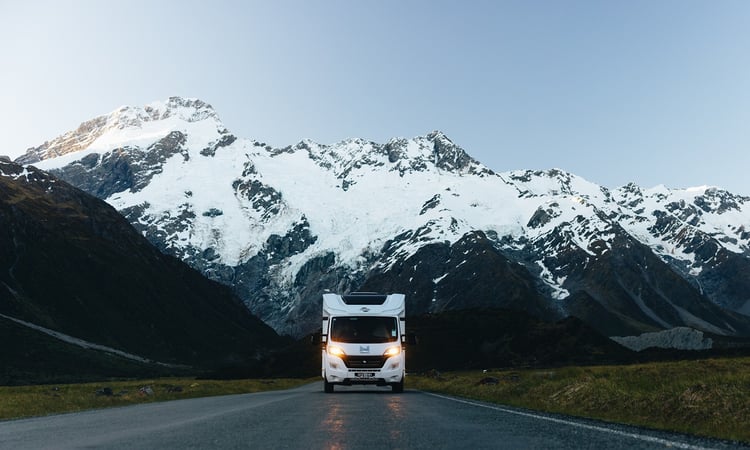
The best piece of advice is not to drive after dark if you can help it. Plan your route to arrive at your Dark Sky destination while it's still light – it’ll be easier for navigation, and if you’re planning to freedom camp, it’ll help you secure the limited spots.
Here are some top tips to help you arrive at your destination safely:
-
If a night drive is unavoidable, keep Google Maps running so you can see winding roads and one-lane bridges coming up in low visibility.
-
South Island rural roads carry real risks after dark: wandering stock, wildlife, and unlit gravel sections that don't show up the way they would in daylight.
-
Rental motorhomes are wider and longer than most people's daily drivers. Give yourself extra braking distance and width buffer on narrow rural roads, especially ones you haven't driven before.
-
In winter, ice risk climbs sharply after dark, which is one more reason to be parked up, not driving, once the sun goes down. It’s also a good idea to let it thaw off in the mornings, rather than setting off immediately at dawn.
-
Always have a confirmed, legal overnight spot decided before you set off. Finding one after dark, in an unfamiliar vehicle, is a scenario you don’t want.