You’re planning your dream trip, and you have twenty tabs open on your computer. One campervan rental company says “$200 per day”, and another says “$500 per day”. Seems like a no-brainer which one to go for, right?
That’s before you realise the “cheap” option comes with a $900 one-way travel fee (yes, you read that right!), a $200 weekend pick-up fee, a public holiday fee, and a service fee. On top of that, it doesn’t include blankets, towels, or toilet paper.
Now you have to buy a bunch of add-ons, and you spend your first hours in New Zealand buying equipment you’ll only use for a week. By the end, your bank account doesn’t look like you’ve been on a budget trip at all.
Being lured in with a cheap-looking headline rate is a common mistake travellers make. It’s like buying a seat on a cheap airline, then realising that bringing your purse costs extra.
In this guide, we’ll explore why premium, all-inclusive pricing models often offer the best value for money – and in many cases, even end up cheaper than a rental with a lower daily rate. We’ll provide real, worked examples and compare different operator packages so you can see the maths for yourself.
What hidden costs and exclusions make 'cheap' campervan rentals not so cheap?
A cheap daily rate pays for the vehicle. The insurance that stops you paying thousands of dollars after a scrape, the chairs you sit on outside, the towels and linen you use, and the fee for dropping off in a different city or picking up on the weekend are often extra. On a two-week trip, those extras can add hundreds, or even thousands, of dollars.
Most of the extra costs fall into five buckets:
-
Running costs: Fuel (less efficient vehicles cost more to run), Road User Charges (RUC) on diesel vehicles, gas refills, and tolls.
-
Insurance and bonds: The excess you're liable for if something goes wrong, the bond held on your card, and the daily cost of reducing it.
-
Equipment and add-ons: Camping chairs, tables, heaters, child seats, linen, and the like.
-
Fees: One-way fees, additional driver fees, public holiday surcharges, location fees, cleaning, and card surcharges.
-
Accommodation: Where you sleep each night, which depends heavily on whether your vehicle is certified self-contained, heated, and well-insulated.
A worked example: how a headline rate grows
Let’s follow a hypothetical couple – newlyweds Sophia and Sam – on a one-week trip from Auckland to Christchurch, travelling in November. They want some extra space, so they’ve narrowed it down to two 4-berth vehicles, both with $0 excess: a budget pop-top campervan from Indie Campers and a more luxurious Wilderness Twin/King for 4.
We went through the booking process on each operator’s website. These are the quotes we got in October 2026.
|
|
Indie Campers |
Wilderness |
|
Advertised rate |
$263 a night |
$539 a day |
|
Rental cost |
$1,470 |
$4,312 |
|
Preparation fee |
$596 |
$0 |
|
Service fee |
$412 |
$0 |
|
One-way fee |
$984 |
$0 |
|
Insurance ($0 excess) |
$782 |
$672 |
|
Bedding kit |
$129 |
$0 |
|
Kitchen kit |
$70 |
$0 |
|
After-trip cleaning |
$197 |
$0 |
|
Extras (table and chairs, barbecue, towels, gas) |
$377 |
$0 (included with Full Cover) |
|
Total |
$4,998 |
$4,984 |
That $263 campervan really costs about $714 a night – more than three times its original headline rate. That’s more or less on par with the Wilderness motorhome, a premium European vehicle with road user charges and tolls included.
Think about what’s happened there – Sophia and Sam went for the “budget” option to save on costs, and it’s ended up costing roughly the same as the luxury option.
Now, if a family were travelling in the winter and needed child seats and snow chains, the “budget” figure would go up even higher. Wilderness includes all of these extras as part of its Full Cover year-round.
Watch out for one-way fees
As you might have noticed, the one-way fee in this example brings the cost of the “budget” option up by a lot. Not all operators charge this much, but most do have one-way fees of $200-300, or more, plus extra fees for collecting your camper on a weekend, public holiday, or at a “premium location” like Queenstown.
Make sure you’re aware of these avoidable fees when budgeting – and where possible, book with an all-inclusive operator like Wilderness, where these fees simply don’t exist!
The non-financial costs
The pure logistical stress of a difficult trip can be just as exhausting as paying more than you need. And if something does go wrong, there’s a huge difference between being left on your own and having reliable 24/7 support.
Here are the top things you should consider in a rental, besides your wallet:
-
Airport pick-ups: Is there a free transfer, and does it run when your flight lands? A taxi from the airport to an off-site depot is an extra cost that a free shuttle service avoids.
-
Waiting for your vehicle: Will you be standing around for hours in a depot, or waiting in comfort? Premium operators like Wilderness will make sure you’re happy with a comfy seat and a tea or coffee if there’s anyone ahead of you.
-
Induction quality: A rushed 10-minute walkthrough can leave you fumbling with the toilet cassette in the dark on night one. A proper handover with time for questions makes the first few days far smoother.
-
On-road support: If the water pump stops working in Haast, who do you call? Check whether the helpline is staffed 24/7 and whether it's a real person who can help.
-
Road restrictions: Many operators ban unsealed roads, which rules out some of New Zealand's best spots. Driving on them anyway can void your insurance. Wilderness has no road restrictions.
-
Vehicle age and reliability: An older, high-kilometre van is more fuel-hungry and more likely to break down, and a lost day waiting for a mechanic is a lost day of your honeymoon.

Before buying our motorhome, we rented from three big motorhome rental brands. First of all, we were kept waiting by all three for about an hour on arrival before seeing a consultant. This was during peak times at Christmas and Easter. The show-through was very basic. The first rental was during a cold Easter, and we were given one fleece blanket and did not know how to use the heating. Everything rattled, and the fit-out was really basic – we only had one towel each, and one tea towel.
The next time, we went for a slightly more premium option with the same company. That wasn't much better – there wasn’t enough basic kitchen stuff like bottle openers, and none of them picked us up from our hotel. The final rental: the water pump packed up after day two. We were in Golden Bay over Christmas, so it could not be fixed as we were too far away. We had to walk all our dirty dishes to the camp kitchen. We couldn't freedom camp, so we paid full campsite fees. The microwave never worked. I called the help desk (based in Australia), which told me that I could just "pop into" the nearest Bunnings and buy one! That would have been a 4-hour return trip, so we didn't bother. None of the operators had enough kitchen utensils, and there was no reimbursement at the end of the hire for the failed equipment – they weren't interested. It wasn't the experience we wanted at all, and we would never rent there again. Cheap is not always best.
Want to know more about how premium campervan operators offer extra value for money? Check out our blog.
How do insurance excess, security bonds and liability reductions affect your New Zealand road trip budget?

Every rental comes with basic insurance, but if the vehicle is damaged, you still pay up to a set amount. That amount is called the excess, and it’s often $5,000–$8,000.
You can either carry that risk, or pay a daily fee to reduce it, usually $40–$95 a day. Over a two-week trip, that’s $560–$1,330 added to your budget.
The real difference between budget and premium operators is what that daily fee gets you. With budget companies, it buys insurance and a few camping extras. With premium operators, it also covers your Road User Charges, gas refills and tolls, so there’s nothing left to pay when you drop the van off.
What your $0 excess buys
Here’s what a typical budget operator’s $0-excess pack includes, compared with Wilderness Full Cover, for a 4-berth vehicle at 2026/27 rates.
For this example, we’ve used Jucy’s New Zealand terms for a 4-berth Condo as of October 2026.
|
|
Jucy, comprehensive pack |
Wilderness Full Cover |
|
Daily cost |
$65 |
$84 |
|
Excess |
$0 |
$0 |
|
Outdoor table and chairs |
Included |
Included |
|
Child seats |
1 included on request |
Included |
|
Snow chains |
Not offered |
Included |
|
Barbecue |
Not offered |
Included |
|
Living-area heating |
Portable heater (needs mains power) |
Built-in gas heating |
|
Windscreen and tyre cover |
Included |
Included |
|
Road User Charges |
N/A (petrol vehicle) |
Included |
|
Gas (LPG) refill |
Not offered |
Included |
|
Tolls |
Extra |
Included |
|
One-way fee |
Extra (approximately $300) |
Doesn’t apply |
|
Weekend fee |
$100 |
Doesn’t apply |
|
Extra drivers |
Included |
Included in every hire |
On the daily fee alone, the budget pack is cheaper: $455 over Sophia and Sam’s 7 days, against $588 for Full Cover. But add the tolls, LPG refill, weekend fee, and one-way fee it doesn’t cover, and the budget option ends up about $400 more expensive.
A friend of mine hired a motorhome from another company for a week. When they made the initial booking, they compared the total daily rate plus insurance only, and decided to book with them. They were unaware of many of the other costs involved. When they picked up, even though they’d purchased insurance for $49 a day, they still had to pay extra for a small fan heater and gas bottles. RUC wasn’t included either. In the end, what they paid in total was not much different from what they would have paid if they’d booked with us. When I told him our price covers lots of the extra costs he paid, he said he wasn’t aware of that.
How do campsite fees and green warrant rules affect cheap campervan travel?
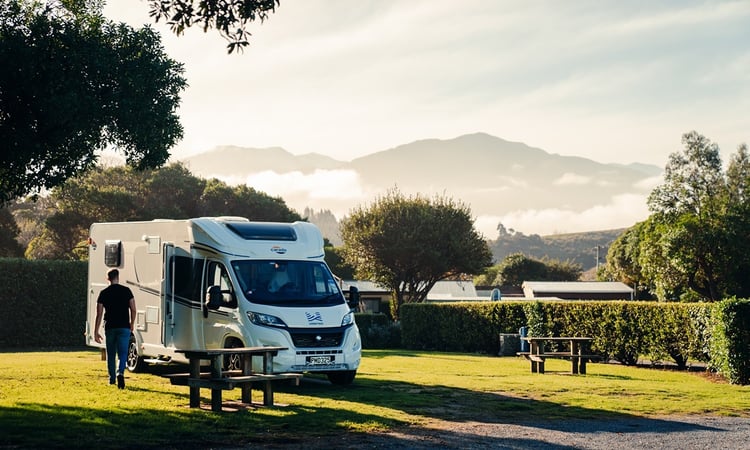
If your van isn’t certified self-contained, you can’t freedom camp on council land, so you’ll pay for a campsite most nights. At around $50–$80 a night for two at a holiday park, that’s up to $560 over a one-week trip.
Many budget operators use converted vans that don’t have a fixed toilet, which means they can’t get a green warrant. Premium motorhomes are built with onboard toilets and water tanks and come certified self-contained, so you have the option to freedom camp.
What is certified self-containment?
A certified self-contained vehicle can look after its own water and waste for a few days without needing any facilities. To be certified, it needs things like fresh and grey water tanks and, crucially, a fixed toilet (it can’t be a portable toilet).
Certified vehicles carry a green warrant card in the window and appear on a national register. The old blue warrant stickers are no longer valid.
Get it wrong, and the fine for freedom camping in a non-certified vehicle in a self-contained-only area is $400. Dumping waste or damaging the site can cost $800. These fines are commonly passed on to your card by the rental company, often with an admin fee on top.
Want to know more about freedom camping in New Zealand? Check out our full guide.
What campsites cost
Even in a self-contained vehicle, you’ll probably want a powered site every few nights to charge devices, do laundry and have a long hot shower. Here are rough prices for two adults:
|
Type of site |
Roughly per night for two adults |
|
Freedom camping (where permitted) |
Free |
|
DOC basic campsite |
Free |
|
DOC standard campsite |
$8–$25 |
|
DOC serviced campsite |
$30–$35 |
|
Holiday park, powered site |
$40–$70, often more in peak season and popular spots |
The difference adds up quickly. Over a 14-night trip, a couple paying for a holiday park every night could spend $500+ more. Mixing freedom camping with a powered site every third night could bring that down to around $200.
I once rented a cheap 2-berth camper, a converted Toyota Estima, in the South Island in April. With it being the shoulder season, I thought temperatures would be reasonable enough that I wouldn’t need heating. But after two nights of shivering and wrapping myself in five layers, I finally caved and booked a bed in a backpacker dorm. That set me back about $500 extra that I hadn’t planned for. Renting a cheaper van without heating outside of peak summer season isn’t a great idea, so keep that in mind when planning!
Are 'premium' operators really much more expensive?
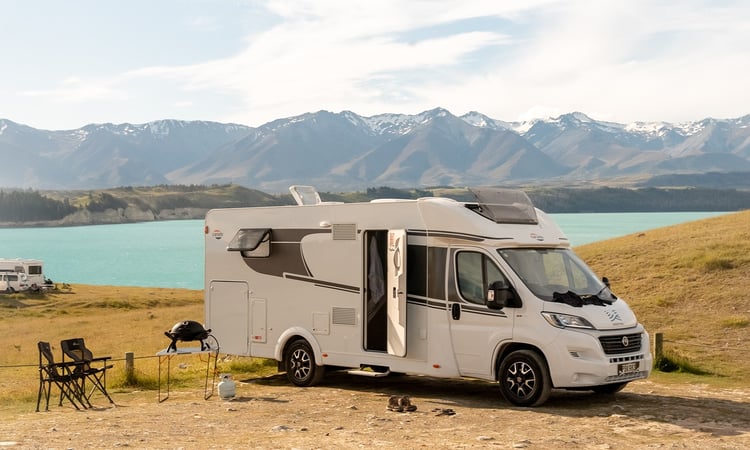
Sometimes, yes. Some budget rentals really are much cheaper, and if every dollar counts, they can be a great way to see New Zealand. But the gap is rarely as big as the daily rates make it look, so it’s always worth getting the final quote before deciding.
Remember Sophia and Sam? On paper, the Wilderness motorhome cost more than twice as much per day as the budget campervan. By the time they’d added the fees, the cover and the gear Wilderness includes as standard, the budget option cost roughly the same – for a converted van instead of a premium motorhome.
That’s why the only fair comparison is total trip cost, with the same route, dates, distance and cover.
Season makes a big difference
In winter, the gap between premium and budget daily rates shrinks. Wilderness rates from June to August sit around $200-300 a day, compared with $650-850 in the December–January peak, so the inclusions can tip the balance even further. You also get crisp days, snowy mountains, and quieter roads.
When a budget option makes sense
A budget van can be the right call if you:
-
Are taking a short trip that starts and ends at the same depot (so there's no one-way fee)
-
Avoid picking up or dropping off on a weekend or public holiday
-
Plan to stay at holiday parks most nights anyway
-
Don't need camping furniture, heating or extra equipment
-
Are comfortable carrying the standard excess, and have travel insurance that covers it
-
Are travelling in summer, when you're less likely to need heating
When all-inclusive tends to win
-
Longer trips, where add-ons and fees multiply
-
One-way journeys between the islands
-
Trips over public holidays, weekends, or in the cooler months
-
If you want to freedom camp, or get off the beaten track on gravel roads
-
If you'd rather have $0 excess and nothing to pay when you drop off
Whichever way you lean, get two or three full quotes for your exact dates and compare the totals, not the daily rates.
Ready to start planning your own road trip? Check out our range of premium motorhomes.